Yellow fever is a serious infection spread by mosquitoes. It is found in parts of Africa, South America, Central America and the Caribbean.
There is a vaccine that can stop you getting it if you are travelling to an area where the infection is found.
Yellow fever vaccination
The yellow fever vaccine is recommended if you are travelling to:
an area where yellow fever is found
a country that requires you to have a certificate proving you have been vaccinated against yellow fever.
You need to have the vaccine at least 10 days before travelling to give it enough time to work. Your certificate will only be valid after this time. The vaccine and certificate are only available from registered yellow fever vaccination centres.
The jab is not usually given for free on the NHS and typically costs around £60 to £80. The vaccine provides lifelong protection, so you will not normally need a booster dose or a new certificate if you have been vaccinated before.
The removal of wisdom teeth, or third molars, is one of the most common surgical procedures carried out in the UK.
The wisdom teeth grow at the back of your gums and are the last teeth to come through. Most people have four wisdom teeth – one in each corner.
Wisdom teeth usually grow through the gums during the late teens or early twenties. By this time, the other 28 adult teeth are usually in place, so there isn't always enough room in the mouth for the wisdom teeth to grow properly.
Because of the lack of space, wisdom teeth can sometimes emerge at an angle or get stuck and only partially emerge. Wisdom teeth that grow through like this are known as impacted.
When to see a dentist
You should make an appointment to see your dentist if your wisdom teeth are causing severe pain. They'll check your teeth and advise you whether they need to be removed.
If your dentist thinks you may need to have your wisdom teeth removed, they'll usually carry out an X-ray of your mouth. This gives them a clearer view of the position of your teeth.
As with any teeth problems, it's important to see your dentist as soon as possible, rather than waiting for your regular dental check-up.
Your wisdom teeth don't usually need to be removed if they're impacted but aren't causing any problems. This is because there's no proven benefit of doing this and it carries the risk of complications.
Sometimes, wisdom teeth that have become impacted or haven't fully broken through the surface of the gum can cause dental problems. Food and bacteria can get trapped around the edge of the wisdom teeth, causing a build-up of plaque, which can lead to:
gum disease (also called gingivitis or periodontal disease)
pericoronitis – when plaque causes an infection of the soft tissue that surrounds the tooth
cellulitis – a bacterial infection in the cheek, tongue or throat
abscess – a collection of pus in your wisdom teeth or the surrounding tissue as a result of a bacterial infection
cysts and benign growths – very rarely, a wisdom tooth that hasn't cut through the gum develops a cyst (a fluid-filled swelling)
Many of these problems can be treated with antibiotics and antiseptic mouthwash.
Wisdom teeth removal is usually recommended when other treatments haven't worked.
Dentists and surgeons follow nationally approved guidelines for the removal of wisdom teeth.
How wisdom teeth are removed
Your dentist may remove your wisdom teeth, or they may refer you to a specialist surgeon for hospital treatment.
Before the operation, the procedure will usually be explained to you and you may be asked to sign a consent form.
You'll usually be given a local anaesthetic injection to numb the area around the tooth. You'll feel some pressure just before the tooth is removed, as your dentist or oral surgeon needs to widen the tooth socket by rocking the tooth back and forth.
A small cut in the gum is sometimes necessary, and the tooth may need to be cut into smaller pieces before it's removed.
It takes anything from a few minutes to 20 minutes, or sometimes even longer, to remove a wisdom tooth.
After your wisdom teeth have been removed, you may have swelling and discomfort, both inside and outside your mouth. Occasionally, some mild bruising is also visible. This is usually worse for the first 3 days, but it can last for up to 2 weeks.
As with all surgery, there are risks associated with removing a wisdom tooth. These include infection or delayed healing, both of which are more likely if you smoke during your recovery.
Another possible complication is "dry socket", which is a dull, aching sensation in your gum or jaw, and sometimes a bad smell or taste coming from the empty tooth socket. Dry socket is more likely if you don't follow the after-care instructions given by your dentist.
There's also a small risk of nerve damage, which can cause a tingling or numb sensation in your tongue, lower lip, chin, teeth and gums. This is usually temporary, but in rare cases it can be permanent.
It can take several hours for the symptoms to develop after you injure your neck. The symptoms are often worse the day after the injury, and may continue to get worse for several days.
When to get medical advice
Visit your GP if you've recently been involved in a road accident, or you've had a sudden impact to your head and you have pain and stiffness in your neck.
They'll ask how the injury happened and about your symptoms. They may also examine your neck for muscle spasms and tenderness, and may assess the range of movement in your neck.
Scans and tests such as X-rays will usually only be carried out if a broken bone or other problem is suspected.
Causes of whiplash
Whiplash can occur if the head is thrown forwards, backwards or sideways violently.
Common causes of whiplash include:
road traffic accidents and collisions
a sudden blow to the head – for example, during sports such as boxing or rugby
a slip or fall where the head is suddenly jolted backwards
being struck on the head by a heavy or solid object
Treatments for whiplash
Whiplash will usually get better on its own or after some basic treatment.
Treatments for whiplash include:
keeping your neck mobile and continuing with your normal activities – using a neck brace or collar isn't recommended
painkillers such as paracetamol or ibuprofen – stronger painkillers are available on prescription if these don't help
The length of time it takes to recover from whiplash can vary and is very hard to predict.
Many people will feel better within a few weeks or months, but sometimes it can last up to a year or more.
Severe or prolonged pain can make it difficult to carry out daily activities and enjoy your leisure time. It may also cause problems at work and could lead to anxiety or depression.
Try to remain positive and focus on your treatment objectives. But if you do feel depressed, speak to your GP about appropriate treatment and support.
Weight loss surgery, also called bariatric or metabolic surgery, is sometimes used as a treatment for people who are very obese.
It can lead to significant weight loss and help improve many obesity-related conditions, such as type 2 diabetes or high blood pressure.
But it's a major operation and in most cases should only be considered after trying to lose weight through a healthy diet and exercise.
NHS weight loss surgery
Weight loss surgery is available on the NHS for people who meet certain criteria.
These include:
you have a body mass index (BMI) of 40 or more, or a BMI between 35 and 40 and an obesity-related condition that might improve if you lost weight (such as type 2 diabetes or high blood pressure)
you've tried all other weight loss methods, such as dieting and exercise, but have struggled to lose weight or keep it off
you agree to long-term follow-up after surgery – such as making healthy lifestyle changes and attending regular check-ups
Speak to your GP if you think weight loss surgery may be an option for you. If you qualify for NHS treatment, they can refer you for an assessment to check surgery is suitable.
You may can also pay for surgery privately, although this can be expensive.
Weight loss surgery can achieve dramatic weight loss, but it's not a cure for obesity on its own.
You'll need to commit to making permanent lifestyle changes after surgery to avoid putting weight back on.
You'll need to:
change your diet – you'll be on a liquid or soft food diet in the weeks after surgery, but will gradually move onto a normal balanced diet that you need to stay on for life
exercise regularly – once you've recovered from surgery, you'll be advised to start an exercise plan and continue it for life
attend regular follow-up appointments to check how things are going after surgery and get advice or support if you need it
Women who have weight loss surgery will also usually need to avoid becoming pregnant during the first 12 to 18 months after surgery.
You may be able to reduce your risk of vulval cancer by stopping smoking and taking steps to reduce the chances of picking up an HPV infection.
How vulval cancer is treated
The main treatment for vulval cancer is surgery to remove the cancerous tissue from the vulva and any lymph nodes containing cancerous cells.
Some people may also have radiotherapy, where radiation is used to destroy cancer cells, or chemotherapy, where medicine is used to kill cancer cells, or both.
Radiotherapy and chemotherapy may be used without surgery if you're not well enough to have an operation, or if the cancer has spread and it's not possible to remove it all.
Outlook
The outlook for vulval cancer depends on things such as how far the cancer has spread, your age, and your general health.
Generally, the earlier the cancer is detected and the younger you are, the better the chances of treatment being successful.
Overall, around 7 in every 10 women diagnosed with vulval cancer will survive at least 5 years.
But even after successful treatment, the cancer can come back.
You'll need regular follow-up appointments so your doctor can check if this is happening.
Can vulval cancer be prevented?
It's not thought to be possible to prevent vulval cancer completely, but you may be able to reduce your risk by:
practising safer sex – using a condom during sex can offer some protection against HPV
attending cervical screening appointments – cervical screening can detect HPV and precancerous conditions such as VIN
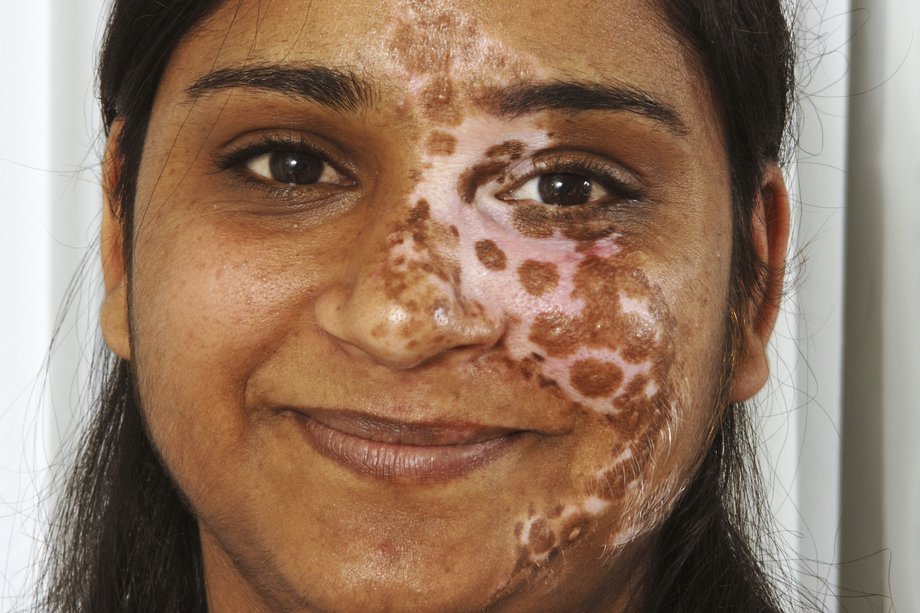
Vitiligo is a long-term condition where pale white patches develop on the skin. It's caused by the lack of melanin, a pigment in the skin.
Vitiligo can affect any area of skin, but most commonly occurs on the face, neck and hands, and in skin creases.
The pale areas of skin are more vulnerable to sunburn, so it's important to take extra care when in the sun and use a sunscreenwith a high sun protection factor (SPF).
Symptoms of vitiligo
The areas most commonly affected by vitiligo include:
the skin around your mouth and eyes
fingers and wrists
armpits
groin
genitals
inside your mouth
It can also sometimes develop where there are hair roots, such as on your scalp. The lack of melanin in your skin can turn the hair in the affected area white or grey.
Vitiligo often starts as a pale patch of skin that gradually turns completely white. The centre of a patch may be white, with pale skin around it. If there are blood vessels under the skin, the patch may be slightly pink, rather than white.
The edges of the patch may be smooth or irregular. They're sometimes red and inflamed, or there's brownish discolouration (hyperpigmentation).
Vitiligo doesn't cause discomfort to your skin, such as dryness, but the patches may occasionally be itchy.
The condition varies from person to person. Some people only get a few small, white patches, but others get bigger white patches that join up across large areas of their skin.
There's no way of predicting how much skin will be affected. The white patches are usually permanent.
Types of vitiligo
There are two main types of vitiligo:
non-segmental vitiligo
segmental vitiligo
In rare cases, it's possible for vitiligo to affect your whole body. This is known as universal or complete vitiligo.
Non-segmental vitiligo
In non-segmental vitiligo (also called bilateral or generalised vitiligo), the symptoms often appear on both sides of your body as symmetrical white patches.
Symmetrical patches can appear on the:
backs of your hands
arms
skin around body openings, such as the eyes
knees
elbows
feet
Non-segmental vitiligo is the most common type of vitiligo, affecting around 9 out of 10 people with the condition.
Segmental vitiligo
In segmental vitiligo (also known as unilateral or localised vitiligo), the white patches only affect one area of your body.
Segmental vitiligo is less common than non-segmental vitiligo, although it's more common in children. It usually starts earlier and affects 3 in 10 children with vitiligo.
What causes vitiligo?
Vitiligo is caused by the lack of a pigment called melanin in the skin. Melanin is produced by skin cells called melanocytes, and it gives your skin its colour.
In vitiligo, there aren't enough working melanocytes to produce enough melanin in your skin. This causes white patches to develop on your skin or hair. It's not clear exactly why the melanocytes disappear from the affected areas of skin.
Autoimmune conditions
Non-segmental vitiligo (the most common type) is thought to be an autoimmune condition.
In autoimmune conditions, the immune system doesn't work properly. Instead of attacking foreign cells, such as viruses, your immune system attacks your body's healthy cells and tissue.
If you have non-segmental vitiligo, your immune system destroys the melanocyte skin cells that make melanin.
Vitiligo is also associated with other autoimmune conditions, such as hyperthyroidism (an overactive thyroid gland), but not everyone with vitiligo will develop these conditions.
Risk factors
You may be at increased risk of developing non-segmental vitiligo if:
other members of your family have it
there's a family history of other autoimmune conditions – for example, if one of your parents has pernicious anaemia (an autoimmune condition that affects the stomach)
you have another autoimmune condition
you have melanoma (a type of skin cancer) or cutaneous T-cell lymphoma (cancer of the lymphatic system)
you have particular changes in your genes that are known to be linked to non-segmental vitiligo
Neurochemicals
Segmental vitiligo (the less common type) is thought to be caused by chemicals released from the nerve endings in your skin. These chemicals are poisonous to the melanocyte skin cells.
Triggers
It's possible that vitiligo may be triggered by particular events, such as:
stressful events, like childbirth
skin damage, such as severe sunburn or cuts (this is known as the Koebner response)
exposure to certain chemicals – for example, at work
Vitiligo isn't caused by an infection and you can't catch it from someone else who has it.
Diagnosing vitiligo
Your GP will be able to diagnose vitiligo after examining the affected areas of skin.
They may ask whether:
there's a history of vitiligo in your family
there's a history of other autoimmune conditions in your family
you've injured the affected areas of skin – for example, whether you've had sunburn or a severe rash there
you tan easily in the sun, or whether you burn
any areas of skin have got better without treatment, or whether they're getting worse
you've tried any treatments already
Your GP may also ask you about the impact vitiligo has on your life. For example, how much it affects your confidence and self-esteem, and whether it affects your job.
Wood's lamp
If available, your GP may use an ultraviolet (UV) lamp called a Wood's lamp to look at your skin in more detail. You'll need to be in a dark room and the lamp will be held 10 to 13cm (4 to 5in) away from your skin.
The patches of vitiligo will be easier to see under the UV light, which will help your GP distinguish vitiligo from other skin conditions, such as pityriasis versicolor (where there's a loss of pigment due to a fungal infection).
Other autoimmune conditions
As non-segmental vitiligo is closely associated with other autoimmune conditions, you may be assessed to see whether you have any symptoms that could suggest an autoimmune condition, such as: