Showing posts with label Burns and Scalds. Show all posts

Burns and scalds - Prevention

Prevention-Burns and scalds


Many severe burns and scalds affect babies and young children. The following advice can help reduce the likelihood of your child having a serious accident.

In the kitchen

  • it's best to keep your toddler out of the kitchen, well away from kettles, saucepans and hot oven doors – you could put a safety gate across the doorway to stop them getting in
  • use a kettle with a short or curly cord to stop it hanging over the edge of the work surface, where it could be grabbed
  • when cooking, use the rings at the back of the cooker and turn saucepan handles towards the back so your child can't grab them
Burns and scalds - Complications

Complications-Burns and scalds


Burns and scalds can sometimes lead to further problems, including shock, heat exhaustion, infection and scarring.

Shock

After a serious injury, it's possible to go into shock. Shock is a life-threatening condition that occurs when there's an insufficient supply of oxygen to the body.
It's possible to go into shock after a serious burn.
Signs and symptoms of shock include:
  • a pale face
  • cold or clammy skin
  • a rapid pulse
  • fast, shallow breathing
  • yawning
  • unconsciousness
Dial 999 and ask for an ambulance if you think someone who's been seriously injured is going into shock.
While you wait for the ambulance:
  • lay the person down (if their injuries allow it) and raise and support their legs
  • use a coat or blanket to keep them warm, but do not cover their face or the burnt area
  • do not give them anything to eat or drink

Burns and scalds - Recovery

Recovery-Burns and scalds


How long it takes to recover from a burn or scald depends on how serious it is and how it's treated. If the wound becomes infected, seek further medical attention.

Burns that don't need medical attention

If your burn or scald is mild and treated at home, it normally heals without the need for further treatment.
While the skin heals, keep the area clean and do not apply any creams or greasy substances. Do not burst any blisters as this can lead to infection.
If you have scalded the inside of your mouth by drinking something hot, try to avoid things that can irritate the scalded area, such as hot and spicy food, alcohol and smoking, until the area heals.
Mild burns or scalds that only affect the uppermost layer of skin (superficial epidermal burns) usually heal in about a week without any scarring.

Burns and scalds - Treatment

Treatment-Burns and scalds


Appropriate first aid must be used to treat any burns or scalds as soon as possible. This will limit the amount of damage to your skin.
You can apply the following first aid techniques to yourself or another person who's been burnt.

First aid for burns

  • Stop the burning process as soon as possible. This may mean removing the person from the area, dousing flames with water, or smothering flames with a blanket. Do not put yourself at risk of getting burnt as well.
  • Remove any clothing or jewellery near the burnt area of skin, including babies' nappies. But do not try to remove anything that's stuck to the burnt skin, as this could cause more damage.
  • Cool the burn with cool or lukewarm running waterfor 20 minutes as soon as possible after the injury. Never use ice, iced water, or any creams or greasy substances like butter.
  • Keep yourself or the person warm. Use a blanket or layers of clothing, but avoid putting them on the injured area. Keeping warm will prevent hypothermia, where a person's body temperature drops below 35C (95F). This is a risk if you're cooling a large burnt area, particularly in young children and elderly people.
  • Cover the burn with cling film. Put the cling film in a layer over the burn, rather than wrapping it around a limb. A clean clear plastic bag can be used for burns on your hand.
  • Treat the pain from a burn with paracetamol or ibuprofen. Always check the manufacturer's instructions when using over-the-counter medication. Children under 16 years of age should not be given aspirin.
  • Sit upright as much as possible if the face or eyes are burnt. Avoid lying down for as long as possible, as this will help reduce swelling.

Burns and scalds - Overview

Overview-Burns and scalds


Burns and scalds are damage to the skin usually caused by heat. Both are treated in the same way.
A burn is caused by dry heat – by an iron or fire, for example. A scald is caused by something wet, such as hot water or steam.
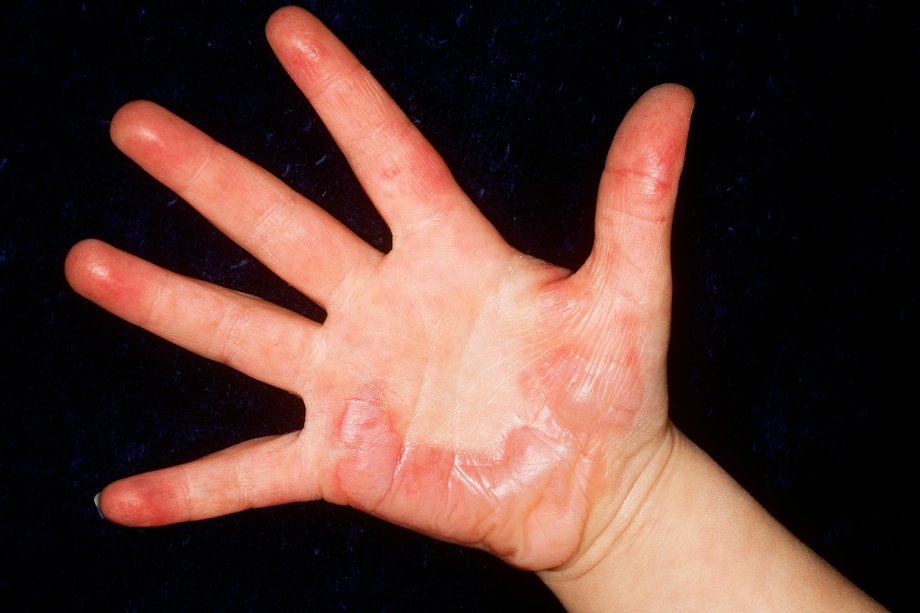
Picture of a burn on the hand
Burns can be very painful and may cause:
  • red or peeling skin
  • blisters 
  • swelling
  • white or charred skin
The amount of pain you feel isn't always related to how serious the burn is. Even a very serious burn may be relatively painless.